What tools do you need to make DIY guitar pedals?

When I decided to make my own DIY guitar effects, I was totally lost about the tools that I needed: what do I need to build guitar effects? How much does a good soldering iron cost? And what is a good soldering iron? Where can I buy all that?

In this post, I will try to answer all these questions that we ask ourselves when starting. Lets focus on tools! 🛠️

Electronics bench
(My bench. It is almost never that clean haha!)

Tutoriel: how to prototype with a breadboard

Prototyping is not always an easy task with guitar pedals. One solution is to heavily mod an existing pedal. But what if you want to start from scratch? How to test things before designing a circuit and solder everything?

Well, we have a simple solution for that: using a breadboard!
DIY guitar effect breadboard

Let's go! In this blog post, we'll see why the breadboard is such a cool tool and how you can use it to design and test your own circuits.


Make your own DIY power supply: yay or nay?

Let's be honest: buying a power supply is not the funniest thing ever.

It is quite expensive (and I have to admit that I would have prefered to add another fuzz that I do not need a nice pedal to my pedalboard than a power supply! 😁) and differences between the several models on the market is not very obvious...

So I asked myself: is it possible to make a DIY power supply?

Power Supply Carl Martin Pro Power

In this blog post, I will explain how a power supply work, what are the good criterias to choose one from an electronics point of view and if it is a good idea to make one yourself. Let's go!

Why I publish my circuits schematics (and why you should do the same!)

When I made my first commercially available pedals, I chose to publish the circuit schematic online. Transparency always has been a missing thing in the guitar pedal marketing world, so it was a very natural move for me.

However, when I spoke about it with friends or colleagues, they all said to me: "why would you do this? You undermine your business by publishing everything!"
Coda Effects Dolmen Fuzz


So here are my answers about why I think being transparent is a must when making guitar pedals, and why I think you should do the same if you build guitar pedals.

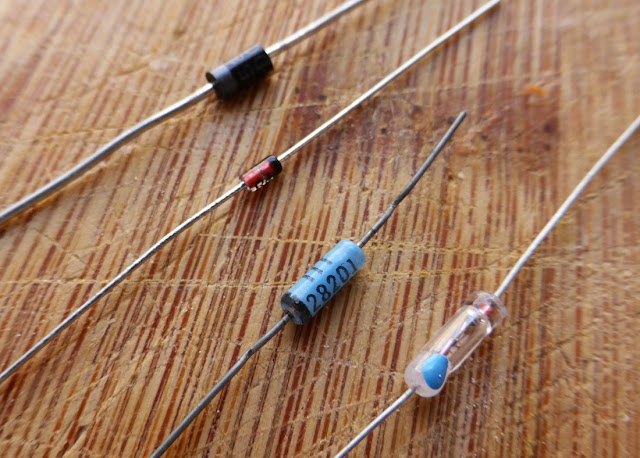
The different types of diodes

There is a very common marketing point that we see all the time with "boutique" guitar pedals: the famous vintage ultra-rare licorn-made type of diodes! Germanium diodes are often associated with a vintage and warm tone, whereas silicium diode sound harsher and fuzzier...
diode types

Time for a blog post about it!

What is a diode? How do they work? Which one should I use when making guitar effects?

Univox Superfuzz (from the 70s): history (post 1/2)

People say that I worship the Univox Superfuzz a bit too much, but they are wrong. If I could, I would already have started a sect about this pedal!

It is simply my favorite pedal of all times! First because of its amazingly cool look with the huge "Super Fuzz" rubber pad, and also for its sound that is crazy loud and heavy. Seriously, best-fuzz-out-there!

After seeing Fu Manchu live in March, I could not resist buying one. After selling a kidney on the black market, I was quite lucky because I found a non-working unit on ebay that I could repair by replacing a few electrolytic capacitors.

Univox Super Fuzz

The Super Fuzz is really the ultimate fuzz for me, so I decided to honor it by writing the most complete article about it. Here is the first part!

Let's go!

Best capacitors for guitar pedals: which one to choose?

I like to say that electronics are like Legos.

If you step on it, it hurts! Just kidding, it seriously works like Legos as well! 😃

You have to choose different bricks (the electronic components: resistors, capacitors, diodes, IC...) and to assemble all of them following a schematic.

The only problem is: like there are different colors for the lego bricks, electronic components are declined in various versions, with the same value.

For instance, many many different capacitors can be found with the same capacitance value: Panasonic SMF, Wima MKP2, FKP2, MKT standard... What a mess! Lets try to make order in all of this, and to see which capacitors are best suited for our use (guitar pedals).


The 6 elements of capacitors

There are globally 6 main types of capacitors: electrolytic, ceramic, film, tantalum, polystyrene and silver-mica capacitors.

The type of the capacitor is simply a description of what it is made of. 

You should also look up for the capacitor working voltage (more on that in a bit). The tolerance of a capacitor is the maximum difference between a capacitor theoritical value and its real value. You should always look for that too; some capacitors can have tolerance values as huge as 40%!

The smaller the tolerance, the better. 😊

Here are a few examples of through-hole capacitors. From left to right: 150pF ceramic capacitor, 1uF tantalum capacitor, 10nF Panasonic SMF film capacitor, 10uF Panasonic FC electrolytic capacitor and a 0.33uF Wima MKP2 film capacitor.

type of capacitors guitar pedals

How to build your first DIY guitar pedal (step by step tutorial)

You have never made a guitar pedal before? You are a bit lost and do not know where to start?

Here is the perfect place! I decided to write a full tutorial for beginners, to build an Earthquaker Device Acapulco Gold, step by step. No excuse not to get started!

The Acapulco Gold is a simple, yet very fun pedal to play with, and is perfect for beginners. The circuit is simple and easy to mod as well. With this tutorial, you should be able to build your first guitar pedal!

If everything goes well, you should get a guitar pedal like this in the end:

Your first DIY guitar pedal

Debugging DIY guitar effects

Rule #1 in guitar pedal building is: "It NEVER works at the first attempt"

So you will have to learn quite quickly what to do when one of your wonderful DIY guitar pedal is not functional. Fortunately, beginners or tired experts often make the same very common mistakes.

Debugging guitar effects

In this article, I made a small list of things to check when your pedal does not work, from the most common to the least common errors. This is of course not an exhaustive list, but it includes a set of common problems and errors that you will surely encounter one day.

Here is my small troubleshooting guide.

Sovtek Bubble Font Russian Big Muff (1995)

A pedal that I recently fixed and a legend in the stoner/doom scene: ladies and gentlemen, here is the almighty Russian Sovtek Big Muff!

Sovtek Big Muff Bubble Font

This lady is already more than 20 year old. Not as old as the 50 years old Maestro Fuzztone that I fixed before, but still!