Showing posts with label Theory. Show all posts

Make your own DIY power supply: yay or nay?

Let's be honest: buying a power supply is not the funniest thing ever.

It is quite expensive (and I have to admit that I would have prefered to add another fuzz that I do not need a nice pedal to my pedalboard than a power supply! 😁) and differences between the several models on the market is not very obvious...

So I asked myself: is it possible to make a DIY power supply?

Power Supply Carl Martin Pro Power

In this blog post, I will explain how a power supply work, what are the good criterias to choose one from an electronics point of view and if it is a good idea to make one yourself. Let's go!

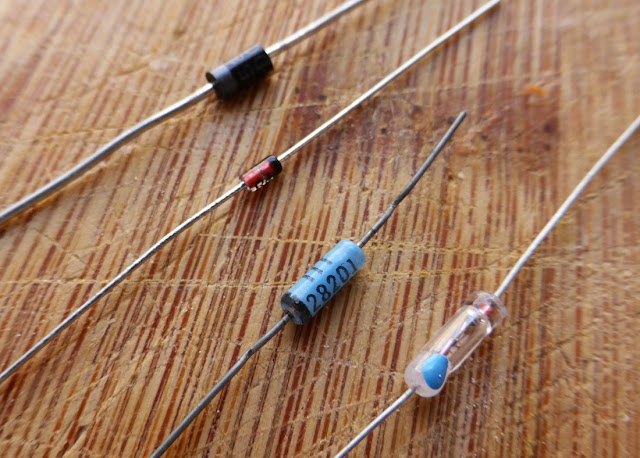
The different types of diodes

There is a very common marketing point that we see all the time with "boutique" guitar pedals: the famous vintage ultra-rare licorn-made type of diodes! Germanium diodes are often associated with a vintage and warm tone, whereas silicium diode sound harsher and fuzzier...
diode types

Time for a blog post about it!

What is a diode? How do they work? Which one should I use when making guitar effects?

Relay Bypass: final code

After the crowdfunding campaign, I decided to update the relay bypass code.

Indeed, this first version was nice, but one main drawback that was feedbacked to me is that the switch was activated on release, which was not always very intuitive or easy to handle. Moreover, I wanted to add a "temporary" bypass option in the Montagne Tremolo.

Montange Tremolo Relay Bypass

In this post, I am going to explain a bit the new code and to show you how I did it.

If you have not read my post about Relay Bypass, I highly recommend you to read it before reading this post. All the basics of microcontrollers are presented there.

  Tip! The full code is available on Github. With the relayonpress.c and header.h files, you will have everything needed to code or burn chips.

If you already have a GitHub account, you can Star the project for updates, or Fork it to modify it and make your own Relay Bypass code.

Lets go!

Ground loops and guitar pedals

Yesterday, I received an email from a beginner that decided to make his first guitar pedal. I always enjoy this kind of emails and answering questions is part of the game. This time, he asked me a question that I had several times: "my circuit is noisy, could it be a ground loop?"

Ground loops are part of the legends and myths around DIY guitar pedals. When asking about noise in a setup, it is the most common answer, and is supposed to be the main cause for hum, hiss or other noises that you can have on your first circuits.

Montagne Tremolo PCB

So I decided to write a post about it, starting from the begining:


Tonebender MKIII clone (Aion Electronics Phobos)

Here is my last build: a Tonebender MKIII clone! The tonebender was initially a derivative of the Fuzz Face, a bit closer to an amp distorsion than a fuzz. (read my post about the different types of fuzz) It became quickly famous thanks to a lot of guitarists like Jimmy Page or Jeff Beck.

The MK2 version used two germanium transistors to get fuzzy tones. However, due to the nature of the circuit, the quality of the fuzz was very dependent on the transistor's gain and characteristics, just like in the Fuzz Face. In order to avoid the selection of transistors, the Mk3 version used 3 transistors, so that the quality of the sound is less dependent on the germanium transistors used. Here is my version:

Tonebender MKIII clone Aion Electronics Phobos

Relay bypass with anti pop system: noiseless and clickless true bypass

Did you like my post about relay bypass? At least I did, and now I use it in almost all my pedals! Thus, they are longer lasting, and we avoid the mechanical noises of a 3PDT. However, I noticed something annoying: the relay bypass makes more "pop" noises than the 3PDT, especially with high gain circuits...

Indeed, relays tend to switch from one state to another much quicker than big mechanical 3PDT switches, which causes the "pop" noises to appear. The gainier the pedal, the more it will amplify the pop and make it louder.

So I adapted a system that I have found on Stompville that suppresses all these noises. Here is the result, with a (very) simple "before and after" video:


Tap tempo tremolo DIY: a complex project!

I am currently prototyping a tap tempo tremolo that I conceived. It is quite a big project, and I have been working on it since nearly 6 months now! Like many guitarists, I really like the warm vintage sounds that you can achieve using tremolo (like in "Bang Bang" from Nancy Sinatra), but also the choppy madness that you can get with square waves, like in "Know your enemy" from Rage Against The Machine, or even weird stuff with high speed tremolos... A really cool effect!

I play regularly in a band, and my point of view is that tap tempo is just absolutely needed for rhythmic effects like delays for instance. Thus, I decided to add one in my tremolo. It is not easy to implement a tap tempo, as you have to use digital circuitry, as we will see later... Here is my current prototype:
DIY tremolo with tap tempo
That is a lot of knobs! You can already notice that there are two footswitches: tap tempo (right side), and the true bypass footswitch that is a clickless relay bypass system! I used the relay bypass system that I conceived, which is completely silent, and more reliable than classic 3PDT true bypass. Indeed, 3PDT footswitches are the main reason for guitar pedal failure. The little switch in the middle of the two LED (bypass LED, and tempo LED) allows you to switch the pedal temporarily. This is nice to add some choppy stuffs while you play!

Relay Bypass: conception and relay bypass code

You might already have heard about "relay bypass", or even used it without knowing it. It a different true-bypass system than the classical 3PDT switch. Instead of using a mechanical 3PDT switch, a soft switch, a microcontroller and a relay are combined to turn the effect on and off.

Relay bypass PCB DIY

 So... Why bother? My 3PDT switch is great, don't you think?

Dead Astronaut FX Chasm Reverb

Remember my Dead Astronaut Chasm Reverb PCB? I finally finished it! I left it quite a long time aside my bench, mainly because I did not have time or money to buy and build all the remaining things that needed to be done. Remember, if you want to have one, you can buy one directly from Dead Astronaut, or buy the PCB to make it yourself.

Here is my build: 
Chasm Reverb Prismatic dead astronaut

Potentiometers and guitar effects

Remember my post about resistors in guitar effects? Let's study another component essential for guitar effects: the potentiometer. It is essential for the main reason that it is one of the two components that allow you to modulate the effect of your guitar pedal, in a continuous manner! Thus, you can choose the final volume of your pedal, the intensity of the effect (gain, mix, delay volume...etc). Lets see what is a potentiometer, how it works, and how it is used in a guitar pedal effects.

Black Keys's Big Muff: dealing with mids frequencies

Another Big Muff clone! This time, I was inspired by the Black Keys (if you do not know this band, go check it out, it is awesome!). Dan Auerbach, the guitarist/singer, uses a lot of fuzz effects, and especially a green russian Big Muff, and a Earthquaker Devices Hoof (a Big Muff variant with some interesting modifications as we will see later).

So I decided to basically mix these two variants in one Big Muff! Here it is, a 4-knobbed Big Muff:


Klon Centaur Clone and mods (Aion Refractor)

The Klon Centaur is one of the DIYer's favorite pedal. Indeed, the original version of this mythical overdrive actually costs more than 1500 euros! This pedal is more like a legendary unicorn than a real pedal that you can test one day... Even the reissue, the KTR, which is not hand assembled costs more than 300 dollars... The amount of clones (aka "klones") of this pedal has grown insanely over the years: JHS, Rockett, ARC Effects, Electro Harmonix with the Soul Food, almost every pedal manufacturer has issued their clone, always closer to the original pedal.

Summary

For those who do not know the Klon Centaur yet, it is an overdrive created in the 90s by Bill Finnegan and MIT engineers (yes!), that is probably the "hypest" pedals of all. It was used by many guitarists, including Jeff Beck for instance. It is a three potentiometers overdrive: gain, volume and trebles, famous for the light crunchy tones it provides to your sound. It has also an excellent reputation as a buffer or clean boost. In fact, I have already made Klon buffer PCBs to use it in a patch box.

Recently, different PCB makers made Klon Centaur PCBs available, so you can make your Klon Centaur yourself. I used a PCB from Aion Electronics, the Refractor overdrive. This PCB is amazing, a fantastic work has been done by Aion Electronics to make the circuit fit a 1590B enclosure ! If you want something a bit bigger (for instance if you want to make a Klon-like look), you can use the Madbean Sunking PCB. I also wanted to see if there were audible differences between my EHX Soul Food and a replica of an original Klon Centaur (without the goop ^^).

Here is the result!
Klon centaur clone

All you need to know about resistors in guitar pedals

In this article (that will be part of a series of articles about the different components you can find in a guitar pedal), we will try to decipher the role of a component you surely already know: the resistor! The resistor is a simple 2-legged component. It is the basic brick of every electronic circuit, like the simplest cubic Lego brick. You will find resistors everywhere, it has many, many, many possible uses. Here, we will be interested in its role in guitar pedals.


What does it looks like?

The common resistor looks like a brown / blue cylinder, with rings of different colours and 2 legs.
metal film resistor 

Rub-a-Dub Reverb (1776 Effects)

Here is my latest build, a Rub A Dub reverb! It is a really simple yet useful "always on" reverb that can go from a minimal amount of reverb to long ambient delay washes, I love it! One knob, simplicity at its finest.

Rub a Dub reverb tweed pedal

What is guitar signal?

We hear about it all the time: it should not be degraded, you have to respect it, we can boost it, clip it or digitalize it... What are we talking about? Electric guitar signal of course! As you may know, the vibration of the strings is converted in an electric signal by your pickups, to restitute guitar sound under an electric form. How does it work? How can an electric signal encode pitches or volume? How can it be modified by guitar pedals?  

Electric guitar pickups signal P90
Where it all began: your guitar pickups!

Big Muff Ram's Head clone (73 version)

Here is the Big muff Ram's Head clone I have made recently. The Ram's Head is one of the most iconic Big muff models. Produced in 1973, it was the second issued version of the Big Muff, just after the Triangle model. Multiple versions of the Ram's Head existed until 1977, including the "violet era" Ram's Head that sells around 1000 dollars on ebay! The Ram's Head v2 is well known as it was used by Pink Floyd's guitarist, David Gilmour. He used the Big Muff combined with a boost in order to have a nearly infinite sustain during some solos, like the famous Comfortably Numb's one.
EHX 73 Ram's Head clone

All you ever wanted to know about guitar cables (but were afraid to ask)

Recently, guitar entered the mysterious and magical world of audiophiles. The kind of world where you can buy carbon turntables for 30 000 pounds (yes), anti seismic isolation racks, or cables for 14 000 pounds! Of course, all these expensive devices highly improve the purity and detail of the sound, and finally allow you to listen to mp3 like you should! (Irony inside) Do you recognize the phenomenon? Yes, this is the same thing with guitar, the quest for "THE sound", with expensive guitar pedal effects and cables! Fulltone, George L's, Evidence Audio, Monster Cables... A lot of new "luxury" cable brands! Is there really a difference? What are the characteristics of a "good" cable? How much should it cost?

First, lets demolish some myths about guitar cables together.


Guitar cables myths and legends

1. Gold-plated jack
This first legend around cables comes from the fact that gold is often use in high quality conductors (computers, HiFi...etc), because the conductivity of gold is better than a lot of other metals, and because gold does not corrode. So we would expect an optimal transfer between the jack and the jack input of your amp, guitar pedal...etc. However, 99.999% of effect, amps or guitars have nickel-plated jack inputs! Therefore, the conduction value will be the one of the lowest conductor, that is to say nickel. Moreover, the conduction value of gold compared to nickel is not that much different.
What is more is that gold is a soft metal, the plating quickly wears off the jack when you plug / unplug it a lot. So the gold plating will not corrode (neither will nickel plating anyway, unless you wait for many many many years...), but will goes off the jack! Unless you have a massive gold jack plug (sell your house if you want a pedalboard with those ^^)

gold plated jack vs silver nickel
Here, we can clearly see that only the tip of the jack is gold-plated
Moreover, in most cases the plating is not pure gold
(and surely not for this 0,7 Euros Chinese jack plug)
  

Analogman sunface DIY clone #2

As I was curious, I decided to build another analogman sunface with the NKT275 red dot transistors I got. However, whereas my first Sunface used a veroboard, I decided to use a PCB. The layout I used for this was conceived by Scruffie, and uses a voltage inverter with a MAX1044. A very ingenious system allows you to switch the power off when you unplug the input jack, very useful with 9V battery. However, as the enclosure I used was quite small (1590B from Hammond), I did not have space left for a battery so I decided to go full power supply. Which is also more practical for a pedalboard stompbox that you are not going to move a lot. And with the voltage inverter, any 9V boss like power supply is perfect! I used a 3PDT PCB. It is very practical, and most of all, really really neat looking. I really paid attention to the wiring this time and try to make the cables as short as possible. I am really happy with the result, it is really nice looking inside.
Analog Man Sunface clone