Showing posts with label Tips. Show all posts

What tools do you need to make DIY guitar pedals?

When I decided to make my own DIY guitar effects, I was totally lost about the tools that I needed: what do I need to build guitar effects? How much does a good soldering iron cost? And what is a good soldering iron? Where can I buy all that?

In this post, I will try to answer all these questions that we ask ourselves when starting. Lets focus on tools! 🛠️

Electronics bench
(My bench. It is almost never that clean haha!)

Tutoriel: how to prototype with a breadboard

Prototyping is not always an easy task with guitar pedals. One solution is to heavily mod an existing pedal. But what if you want to start from scratch? How to test things before designing a circuit and solder everything?

Well, we have a simple solution for that: using a breadboard!
DIY guitar effect breadboard

Let's go! In this blog post, we'll see why the breadboard is such a cool tool and how you can use it to design and test your own circuits.


Make your own DIY power supply: yay or nay?

Let's be honest: buying a power supply is not the funniest thing ever.

It is quite expensive (and I have to admit that I would have prefered to add another fuzz that I do not need a nice pedal to my pedalboard than a power supply! 😁) and differences between the several models on the market is not very obvious...

So I asked myself: is it possible to make a DIY power supply?

Power Supply Carl Martin Pro Power

In this blog post, I will explain how a power supply work, what are the good criterias to choose one from an electronics point of view and if it is a good idea to make one yourself. Let's go!

Why I publish my circuits schematics (and why you should do the same!)

When I made my first commercially available pedals, I chose to publish the circuit schematic online. Transparency always has been a missing thing in the guitar pedal marketing world, so it was a very natural move for me.

However, when I spoke about it with friends or colleagues, they all said to me: "why would you do this? You undermine your business by publishing everything!"
Coda Effects Dolmen Fuzz


So here are my answers about why I think being transparent is a must when making guitar pedals, and why I think you should do the same if you build guitar pedals.

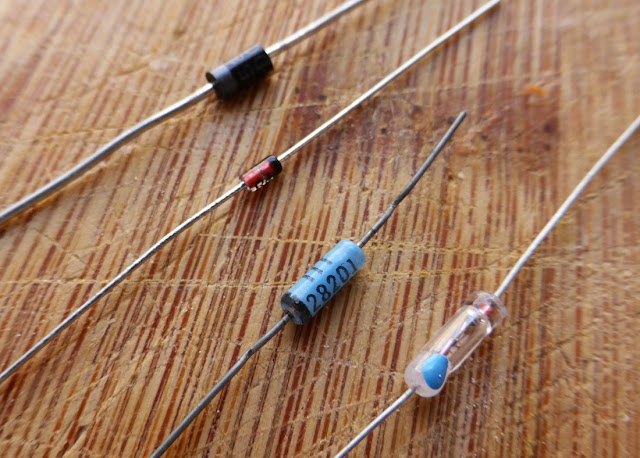
The different types of diodes

There is a very common marketing point that we see all the time with "boutique" guitar pedals: the famous vintage ultra-rare licorn-made type of diodes! Germanium diodes are often associated with a vintage and warm tone, whereas silicium diode sound harsher and fuzzier...
diode types

Time for a blog post about it!

What is a diode? How do they work? Which one should I use when making guitar effects?

Best capacitors for guitar pedals: which one to choose?

I like to say that electronics are like Legos.

If you step on it, it hurts! Just kidding, it seriously works like Legos as well! 😃

You have to choose different bricks (the electronic components: resistors, capacitors, diodes, IC...) and to assemble all of them following a schematic.

The only problem is: like there are different colors for the lego bricks, electronic components are declined in various versions, with the same value.

For instance, many many different capacitors can be found with the same capacitance value: Panasonic SMF, Wima MKP2, FKP2, MKT standard... What a mess! Lets try to make order in all of this, and to see which capacitors are best suited for our use (guitar pedals).


The 6 elements of capacitors

There are globally 6 main types of capacitors: electrolytic, ceramic, film, tantalum, polystyrene and silver-mica capacitors.

The type of the capacitor is simply a description of what it is made of. 

You should also look up for the capacitor working voltage (more on that in a bit). The tolerance of a capacitor is the maximum difference between a capacitor theoritical value and its real value. You should always look for that too; some capacitors can have tolerance values as huge as 40%!

The smaller the tolerance, the better. 😊

Here are a few examples of through-hole capacitors. From left to right: 150pF ceramic capacitor, 1uF tantalum capacitor, 10nF Panasonic SMF film capacitor, 10uF Panasonic FC electrolytic capacitor and a 0.33uF Wima MKP2 film capacitor.

type of capacitors guitar pedals

How to build your first DIY guitar pedal (step by step tutorial)

You have never made a guitar pedal before? You are a bit lost and do not know where to start?

Here is the perfect place! I decided to write a full tutorial for beginners, to build an Earthquaker Device Acapulco Gold, step by step. No excuse not to get started!

The Acapulco Gold is a simple, yet very fun pedal to play with, and is perfect for beginners. The circuit is simple and easy to mod as well. With this tutorial, you should be able to build your first guitar pedal!

If everything goes well, you should get a guitar pedal like this in the end:

Your first DIY guitar pedal

Debugging DIY guitar effects

Rule #1 in guitar pedal building is: "It NEVER works at the first attempt"

So you will have to learn quite quickly what to do when one of your wonderful DIY guitar pedal is not functional. Fortunately, beginners or tired experts often make the same very common mistakes.

Debugging guitar effects

In this article, I made a small list of things to check when your pedal does not work, from the most common to the least common errors. This is of course not an exhaustive list, but it includes a set of common problems and errors that you will surely encounter one day.

Here is my small troubleshooting guide.

Enclosure art: how to make good looking DIY pedals

One of the nicest parts of making guitar pedals is having a personalized design. However, it is quite hard to make good looking guitar pedals.

Here are a few techniques to make guitar enclosures pretty! You can of course combine these techniques to get the best looking pedal possible!

I will present you a lot of techniques, from the most basic ones to the most professional looking ones.


1. Bare aluminum enclosure

It is the simplest way to do: just let the enclosure in bare aluminum.

Please don't do that.
DIY guitar pedal bare aluminum

Relay Bypass: final code

After the crowdfunding campaign, I decided to update the relay bypass code.

Indeed, this first version was nice, but one main drawback that was feedbacked to me is that the switch was activated on release, which was not always very intuitive or easy to handle. Moreover, I wanted to add a "temporary" bypass option in the Montagne Tremolo.

Montange Tremolo Relay Bypass

In this post, I am going to explain a bit the new code and to show you how I did it.

If you have not read my post about Relay Bypass, I highly recommend you to read it before reading this post. All the basics of microcontrollers are presented there.

  Tip! The full code is available on Github. With the relayonpress.c and header.h files, you will have everything needed to code or burn chips.

If you already have a GitHub account, you can Star the project for updates, or Fork it to modify it and make your own Relay Bypass code.

Lets go!

Hakko FX888D: a $100 high quality soldering station

Let's face it: your good old soldering iron is not always the best pal to work with.

I had some troubles with mine: no support to put it when I busy doing something else than soldering, which can be quite dangerous if it falls or burn something. Moreover, the power cord was quite short and not very flexible, so it was not always easy to find a good "spot" for it in order to be perfectly comfortable. Finally, it takes a long time before getting hot enough to solder, and 30W is sometimes a bit low to solder big potentiometer or jack legs.

So I decided to invest a bit in a soldering station.

After reading a lot on the web, I have found this little gem: the Hakko FX888D, a Japanese soldering station that was recently replaced by the FX888DX version you can find for around $150 on Amazon

Here is mine:
Hakko FX888D

14 electronics suppliers for guitar effects (with pros and cons)

Finding good electronics suppliers is a key issue when building guitar effects professionally. Indeed, they play a huge role in traceability and quality of the components (where the components come from and what they are exactly), and also the price of these components. Sometimes, they can also add delays if they are bad with handling orders and shipping it quickly.

Goods electronics suppliers are the root cause of a good build quality for a pedal builder.

With my crowdfunding project, I have an intermediary position. I cannot order directly from manufacturers (because I would have to order thousands of units at least), but I can order from electronics wholesalers!

Already 95% of the components have been ordered, and I already received quite a lot of parts! Here is a picture of the switches I got this morning (more pictures will follow in a next post):


Create your own pedal company: good or bad idea?

If you already have made a few pedals yourself, you surely have thought about selling them or at least build some of them for other people. Create your own guitar pedal brand seems like a good idea on paper, however there are many pitfalls.... Lets talk about it!

Disclaimer: I make effects myself, and this post is not intended to "kill competitors" (with my 30 pedals a year...)! On the contrary, I think it is way better to be transparent and to talk about it: this is only my opinion, and feel free to express yours in the comments section :)

It is a complex matter that is not always easy to discuss peacefully because of money, and there are many different opinions on the subject. It is also the source of really long yet exciting threads on DIY forums (check this one!). The simplest option for me is to discuss it from my point of view as a builder. Thus, I will talk about Coda Effects, and well, just once will not hurt, about me, and give you some tips if you want to jump in it!

Early 2013, I started to show interest in guitar pedal building: after opening a Fuzz Face, I was quite astonished by the simplicity of the circuit (there is almost nothing in there!), and I realized that building guitar effects might be simpler that I thought.

Fuzz Face inside

Eagle for making guitar pedals PCB: getting started (part 1/3)

Sometimes, especially with complicated builds with a lot of components, or when you have to build several times the same pedal, it is easier to use a printed circuit board (PCB) than veroboard or turrets board. A PCB is easier to assemble, and it prevents from doing many mistakes that can occur when using veroboard: false contacts, misplaced component, complicated wiring involving a lot of wires...etc.

"Eagle" is the name of a beautiful animal, but it also stands for "Easily Applicable Graphical Layout Editor", the name of a famous software that helps you to conceive and make printed circuit boards (PCB). I already used it a lot to make PCBs. For instance, I made a few Klon buffer boards with it. I decided to write a serie of articles explaining how to use it to make PCB for your guitar pedals.

2026 Update: Autodesk has announced End of Life for Eagle for June 2026. This is super disappointing, but Eagle seems to be no longer relevant for the guitar pedal community. Alternative is to switch to KiCad, which I will dive into this year. In the meantime, I have saved the popular Gauss Markov library in Eagle XML format and KiCad format (symbols and footprints) on GitHub.


Article parts:
  • Getting started (you are reading this one now)
  • Tracing the circuit (to be published)
  •  Creating the PCB layout (to be published)

EAGLE for DIY pedals
Become free to make PCB like you want with Eagle

Relay bypass with anti pop system: noiseless and clickless true bypass

Did you like my post about relay bypass? At least I did, and now I use it in almost all my pedals! Thus, they are longer lasting, and we avoid the mechanical noises of a 3PDT. However, I noticed something annoying: the relay bypass makes more "pop" noises than the 3PDT, especially with high gain circuits...

Indeed, relays tend to switch from one state to another much quicker than big mechanical 3PDT switches, which causes the "pop" noises to appear. The gainier the pedal, the more it will amplify the pop and make it louder.

So I adapted a system that I have found on Stompville that suppresses all these noises. Here is the result, with a (very) simple "before and after" video:


Ultimate guide to guitar effect wiring: how to wire DIY guitar pedals properly?

Your guitar pedal circuit is finally populated and ready to rock! However, you still have to solder all the wires... I noticed that it was during this step that beginners encounter most of the issues that go along with guitar effects making.

Especially with veroboard, you can quickly get a huge mess of wires going everywhere in the enclosure, with the so-called "spaghetti wiring" that we all achieved at least once when starting to make guitar effects!


Why you should NOT paint your guitar pedal enclosures yourself

I know this is a bit against the concept of DIY, but the more I am spray painting enclosures, the more I notice that the results are not as great as a commercialy available prepainted enclosures.

First, sanding the enclosure is a long and painful task and is mandatory if you want a clean surface to paint on. Avoid the long long hours spent carefully polishing your enclosure !

Then, a lot of thin layers are required if you want a proper painting, and most of the time, the painting will still be fragile and sensitives to shocks. I got craks or scratches on the paint really quickly... Nice if you want a beaten-up, vintage, relic look, but not if you want something really clean and durable. You will end up having something similar to the first tall font russian big muff that had paint quality issue:

Big muff tall font low quality paint

Black Arts Toneworks Pharaoh Fuzz clone

I want to make  Big Muff variants using my Coda Effects Big Muff PCB, and show you how to make them yourself. Lets start with the boutique version of the Big Muff that made it popular again on the stoner / doom scene: the Pharaoh Fuzz! Produced by Black Arts Toneworks since 2011, it was an immediate success because of the huge, warm, doomy sounds it can produce.

Here is my version:
Pharaoh Big Muff clone

Relay Bypass: conception and relay bypass code

You might already have heard about "relay bypass", or even used it without knowing it. It a different true-bypass system than the classical 3PDT switch. Instead of using a mechanical 3PDT switch, a soft switch, a microcontroller and a relay are combined to turn the effect on and off.

Relay bypass PCB DIY

 So... Why bother? My 3PDT switch is great, don't you think?

Guitar effects and reliability: 5 things to improve to make your pedals longer lasting

I am building effects since three years, and now that it has been a while, I noticed first failures on my devices. In this article I am going to describe what are the main causes of guitar effects failures that I noticed or that people report to me, how to repair it, and how to build your pedal to make them long term lasting or easily repairable.
Oxydated chip guitar pedal