Showing posts with label Builds. Show all posts

Development Hell: multiple fuzz pedal

Today, I am going to introduce the concept of Development Hell: it is a special place where projects stay when they need a lot of fine tuning before properly work. Unfortunately, I have a few projects that are still burning there, like the one I am going to present today.

It is a multi-fuzz machine! I always felt that a lot of Fuzz are quite a "one trick pony", they have a very characteristic sound that can be modulated by mods, but still sounds "like a fuzz face", "like a big muff"...etc. Moreover, fuzz are usually quite simple circuits, and I find that allowing one spot per fuzz on a pedalboard can quickly be space-inefficient.

So I decided to create a multi fuzz pedal, with no more than 3 different fuzz inside : a germanium Fuzz Face, a Muff Fuzz and a Companion Fuzz, which should provide the 3 main "flavors" of fuzz in this world: a classic warm, soft fuzz face, a "chainsaw", very raspy Companion Fuzz, and a compressed and heavy Muff Fuzz.

On top of that, I added an upper octave generator that allows to combine it with any fuzz, with a potentiometer to adjust the amount of octave. It is based on the Green Ringer circuit, which is a small, but efficient analog octaver circuit.

And of course, I made it fit in a 125B enclosure...

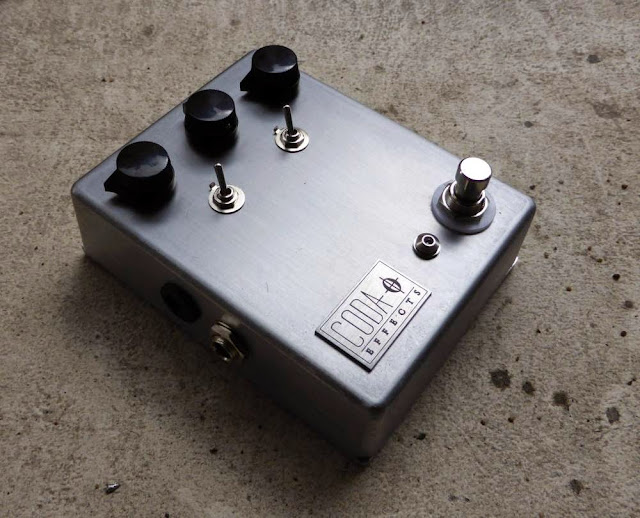
Here it is in its current form:


Tonebender MKIII clone (Aion Electronics Phobos)

Here is my last build: a Tonebender MKIII clone! The tonebender was initially a derivative of the Fuzz Face, a bit closer to an amp distorsion than a fuzz. (read my post about the different types of fuzz) It became quickly famous thanks to a lot of guitarists like Jimmy Page or Jeff Beck.

The MK2 version used two germanium transistors to get fuzzy tones. However, due to the nature of the circuit, the quality of the fuzz was very dependent on the transistor's gain and characteristics, just like in the Fuzz Face. In order to avoid the selection of transistors, the Mk3 version used 3 transistors, so that the quality of the sound is less dependent on the germanium transistors used. Here is my version:

Tonebender MKIII clone Aion Electronics Phobos

Boss Tap Tempo DIY

Here is my latest build, a very simple tap tempo pedal for a Boss DD7 pedal (or any other pedal with external tap tempo). It is very simple : one mono jack, one momentary SPST! Very easy build, I think it is the perfect build to begin with DIY! Tap tempo is very useful if you play in a band, so I think this is really a great way to improve your beloved DD7 guitar pedal.

I used a Hammond 1590LB enclosure, which is really small. However, I did not centered the momentary switch because of the lack of space.

Boss tap tempo pedal

Other Vemuram Jan Ray variants

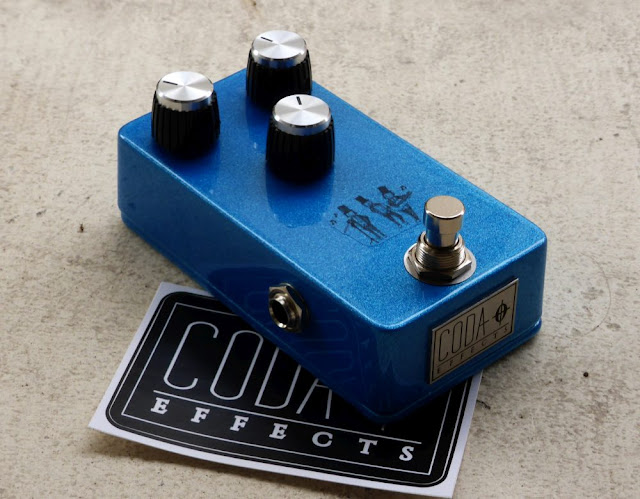
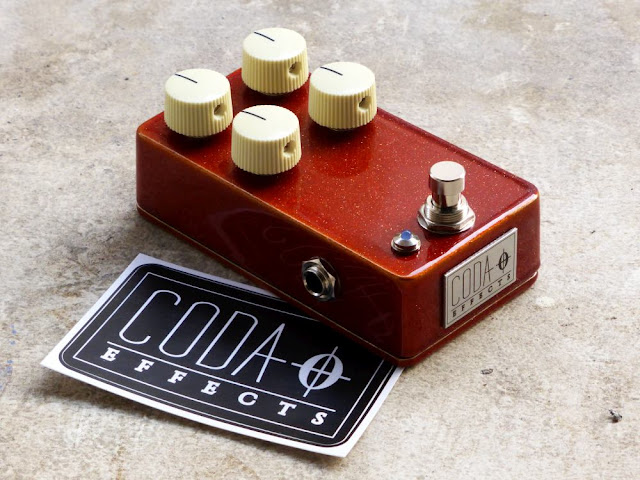
Since I designed my own Jan Ray circuit board, I assembled quite a few. The PCB is quite small, so I have made different variants of various sizes and colors, and I though you migh enjoy it. Here are some of them!

Here is a Jan Ray in a beautiful "mirror" copper color:

Tap tempo tremolo DIY: a complex project!

I am currently prototyping a tap tempo tremolo that I conceived. It is quite a big project, and I have been working on it since nearly 6 months now! Like many guitarists, I really like the warm vintage sounds that you can achieve using tremolo (like in "Bang Bang" from Nancy Sinatra), but also the choppy madness that you can get with square waves, like in "Know your enemy" from Rage Against The Machine, or even weird stuff with high speed tremolos... A really cool effect!

I play regularly in a band, and my point of view is that tap tempo is just absolutely needed for rhythmic effects like delays for instance. Thus, I decided to add one in my tremolo. It is not easy to implement a tap tempo, as you have to use digital circuitry, as we will see later... Here is my current prototype:
DIY tremolo with tap tempo
That is a lot of knobs! You can already notice that there are two footswitches: tap tempo (right side), and the true bypass footswitch that is a clickless relay bypass system! I used the relay bypass system that I conceived, which is completely silent, and more reliable than classic 3PDT true bypass. Indeed, 3PDT footswitches are the main reason for guitar pedal failure. The little switch in the middle of the two LED (bypass LED, and tempo LED) allows you to switch the pedal temporarily. This is nice to add some choppy stuffs while you play!

Black Arts Toneworks Pharaoh Fuzz clone

I want to make  Big Muff variants using my Coda Effects Big Muff PCB, and show you how to make them yourself. Lets start with the boutique version of the Big Muff that made it popular again on the stoner / doom scene: the Pharaoh Fuzz! Produced by Black Arts Toneworks since 2011, it was an immediate success because of the huge, warm, doomy sounds it can produce.

Here is my version:
Pharaoh Big Muff clone

Dead Astronaut FX Chasm Reverb

Remember my Dead Astronaut Chasm Reverb PCB? I finally finished it! I left it quite a long time aside my bench, mainly because I did not have time or money to buy and build all the remaining things that needed to be done. Remember, if you want to have one, you can buy one directly from Dead Astronaut, or buy the PCB to make it yourself.

Here is my build: 
Chasm Reverb Prismatic dead astronaut

Jan Ray in a 1590B with Coda Effects PCB!

Here my latest version of the Jan Ray! This time, instead of the 1590BB or the 125B version, I made a smaller 1590B version, using a PCB that I designed! 

The Jan ray is quite annoying to make on vero, mainly because of the four knobs to wire. A PCB is thus quite helpful to make it easily. Moreover, it allows me to fit it in a 1590B enclosure. Here is the finished pedal:
Vemuram Jan Ray clone

Black Keys's Big Muff: dealing with mids frequencies

Another Big Muff clone! This time, I was inspired by the Black Keys (if you do not know this band, go check it out, it is awesome!). Dan Auerbach, the guitarist/singer, uses a lot of fuzz effects, and especially a green russian Big Muff, and a Earthquaker Devices Hoof (a Big Muff variant with some interesting modifications as we will see later).

So I decided to basically mix these two variants in one Big Muff! Here it is, a 4-knobbed Big Muff:


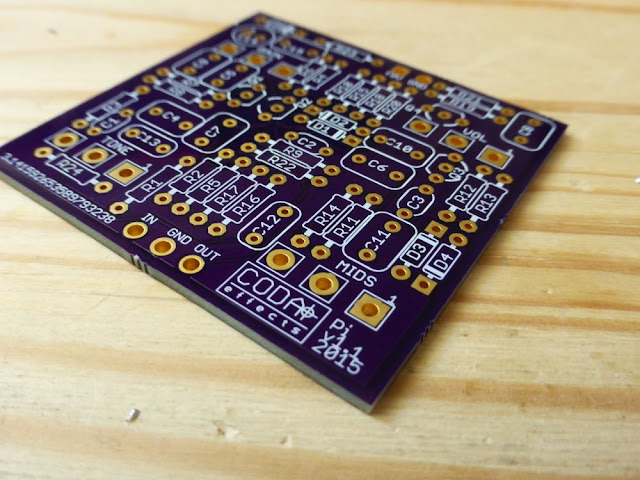
LPB1 mini PCB !

The LPB1 (Line Power Boost 1) is a boost pedal that was commercialized in 1968 by Electro Harmonix. It is the first boost pedal using a silicon transistor. Indeed, previous boosts like the Dallas Rangemaster Treble Booster were using germanium transistors. Another novelty with this pedal was that it was boosting all frequencies and not only trebles, making it the first clean boost available!
  
Vintage EHX LPB-1 boost

Klon Centaur Clone and mods (Aion Refractor)

The Klon Centaur is one of the DIYer's favorite pedal. Indeed, the original version of this mythical overdrive actually costs more than 1500 euros! This pedal is more like a legendary unicorn than a real pedal that you can test one day... Even the reissue, the KTR, which is not hand assembled costs more than 300 dollars... The amount of clones (aka "klones") of this pedal has grown insanely over the years: JHS, Rockett, ARC Effects, Electro Harmonix with the Soul Food, almost every pedal manufacturer has issued their clone, always closer to the original pedal.

Summary

For those who do not know the Klon Centaur yet, it is an overdrive created in the 90s by Bill Finnegan and MIT engineers (yes!), that is probably the "hypest" pedals of all. It was used by many guitarists, including Jeff Beck for instance. It is a three potentiometers overdrive: gain, volume and trebles, famous for the light crunchy tones it provides to your sound. It has also an excellent reputation as a buffer or clean boost. In fact, I have already made Klon buffer PCBs to use it in a patch box.

Recently, different PCB makers made Klon Centaur PCBs available, so you can make your Klon Centaur yourself. I used a PCB from Aion Electronics, the Refractor overdrive. This PCB is amazing, a fantastic work has been done by Aion Electronics to make the circuit fit a 1590B enclosure ! If you want something a bit bigger (for instance if you want to make a Klon-like look), you can use the Madbean Sunking PCB. I also wanted to see if there were audible differences between my EHX Soul Food and a replica of an original Klon Centaur (without the goop ^^).

Here is the result!
Klon centaur clone

Another Jan Ray clone !

Here is a pedal I made, a Vemuram Jan Ray clone!

This time, contrary to my previous Jan Ray clone, I decided to make it in a smaller 125B enclosure. It is not particulary a big deal with this pedal, you just have to be precise, and use a guide. I generally use a plastic card or a piece of cardboard with 4 holes disposed as the holes for the potentiometers on the enclosure, and put the potentiometers inside. Then, I cut and solder an excessive length of wire to the veroboard. I use a wire that you can bend so it can maintain the veroboard. Then, I place the veroboard above the potentiometers, and start to cut the wires at the minimal length, and solder it to the pots.

I used a prepainted enclosure from Banzai music (Vintage Orange sparkle), and classic small MXR style 17mm knobs. I also added a switch similar to the one on the Timmy that allows you to choose between a compressed (2 diodes) and an uncompressed (4 diodes) setting.
Vemuram Jan Ray clone DIY

JHS Superbolt clone / ROG Supreaux

This is a JHS Superbolt clone! JHS is not one of the most honest builders on the planet, and he is known for his ability to steal circuit designs from other builders. The Superbolt is no exception, and is in fact a really slightly modded Run Off Groove Supreaux. Runoffgroove is a community creating circuits for DIY people, and making it public through Creative Common license. There are many nice circuits there, take a look! JHS did not bother with the license and just copy it and started to sell it.

The circuit is inspired by an old class A amplifier, the Supro 16T. It is a small 5W amplifier from the late 60s. It became quite famous, because like many other class A amplifier, if you push the volume really loud, the amp begins to distort in a really nice way. It was used in studio by many guitarists, especially by Jimmy Page who recorded several Led Zeppelin songs with it.

JHS Superbolt clone

Rub-a-Dub Reverb (1776 Effects)

Here is my latest build, a Rub A Dub reverb! It is a really simple yet useful "always on" reverb that can go from a minimal amount of reverb to long ambient delay washes, I love it! One knob, simplicity at its finest.

Rub a Dub reverb tweed pedal

Big Muff Ram's Head clone (73 version)

Here is the Big muff Ram's Head clone I have made recently. The Ram's Head is one of the most iconic Big muff models. Produced in 1973, it was the second issued version of the Big Muff, just after the Triangle model. Multiple versions of the Ram's Head existed until 1977, including the "violet era" Ram's Head that sells around 1000 dollars on ebay! The Ram's Head v2 is well known as it was used by Pink Floyd's guitarist, David Gilmour. He used the Big Muff combined with a boost in order to have a nearly infinite sustain during some solos, like the famous Comfortably Numb's one.
EHX 73 Ram's Head clone

Dead Astronaut FX Chasm Reverb PCB

Today I received a PCB from Dead Astronaut FX, the Chasm Reverb!
Dead Astronaut (alias Robert Henry) is an effects builder based in the United Kingdom. He builds a lot of different effects (fuzz, distorsion, tremolo, delays...), with beautiful etched enclosures.

I recently had a crush on the reverb he makes, the Chasm Reverb. It is a beautiful, deep sounding reverb that can auto-oscillate to create great sounding "waves" of sounds, ideal for post rock or prog rock. It is based on a Belton Brick, an IC allowing builders to make digital reverbs. Moreover, it has interesting options compared to other reverbs: a mix potentiometer to choose the amount of dry and wet signal, and a bypass system that let the reverb ends when you turn the effect off. It is called "trails". There is also a "damp" setting and volume.

You can find demos on youtube (chasm reverb or prismatic reverb) that are really great sounding!

Dead Astronaut can make the Reverb for you, or you can order a PCB to make it yourself. As being a DIYer, I ordered the PCB for a reasonable price of 11 pounds. If you want to make one, you can buy the PCB here. Robert is very helpful and replies quickly to emails, he gave me a lot of useful informations. The PCB is of very good quality, double sided with a nice ground plane. The Chasm reverb layout is quite nice, and not too compressed:

Chasm Reverb layout PCB